Transylvania Unveiled: More Than Just Dracula's...
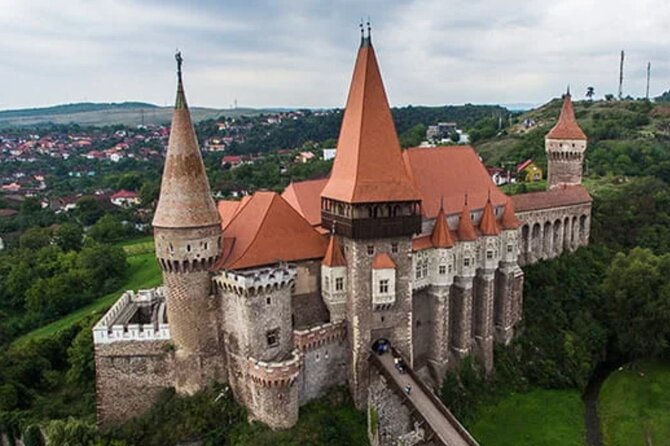
Transylvania. The name conjures images of misty mountains, gothic castles, and, of course, the infamous Count Dracula. But beyond the well-trodden path of vampire lore lies a region rich in history, culture, and… well, perhaps something a little more. I'm Adrian, and I’ve embarked on a journey to uncover the real Transylvania, a land where ancient superstitions intertwine with breathtaking landscapes and where the veil between worlds feels a little thinner. Buckle up, because this trip is going to be anything but ordinary. This is my experience with Transylvania paranormal travel.
My adventure begins in the heart of Brasov, a city steeped in medieval charm.
A Brasov Beginning: Art Nouveau and Apparitions
My first stop is the Hotel Coroana Brasovului (Strada Republicii 62, Brașov 500030, Romania), a stunning example of Art Nouveau architecture. The intricate floral designs and stained-glass windows are captivating, but it was something else that drew me here: the rumors. Before booking, I stumbled upon whispers of ghost sightings on TripAdvisor, tales of unexplained noises and fleeting apparitions. Of course, as a dedicated paranormal investigator, I couldn't resist. The hotel, while beautiful, definitely has a certain…atmosphere.
Next, I checked into the Aro Palace Hotel (Piața Unirii 5, Brașov 500025, Romania), a landmark with a rich history. While it may not be as overtly "haunted" as the Coroana, its historical significance lends it a certain gravitas. You can almost feel the echoes of past dignitaries and whispered political secrets in its grand hallways. No EVPs (Electronic Voice Phenomena) here, but a palpable sense of history nonetheless. This area is ideal for a Brasov paranormal investigation, in my opinion.
For my first taste of Transylvanian cuisine, I ventured to Suba (Strada Michael Weiss 11, Brașov 500007, Romania).
Suba: A Culinary Journey Beyond Expectations
Forget your preconceptions of heavy, meat-laden Romanian food. Suba offers modern interpretations of traditional Transylvanian dishes. I opted for the chef's unique take on goulash, and it was a revelation. The caramelized onions provided a deep, rich sweetness, the beef was unbelievably tender, and the locally sourced paprika added a smoky warmth that lingered on the palate. It was the perfect introduction to the region's culinary delights. These dishes show a commitment to authentic Romanian food, Brasov style.
Piatra Craiului National Park: Into the Bat Caves
The next day, I traded city streets for rugged trails, heading to Piatra Craiului National Park near Zărnești. My destination: the bat caves. Armed with a bat detector (set to 25kHz) and a FLIR ONE Gen 3 thermal camera, I was on a mission to investigate, or perhaps debunk, local legends about vampire bats.

The air inside the caves was noticeably colder, confirmed by the thermal camera. The EMF (electromagnetic field) levels near the entrance spiked erratically. According to my copy of "Transylvanian Superstitions," "Locals claim these caves are gateways to the underworld, where the moroi gather strength." While I didn't encounter any creatures of the night, the ambient temperature drop and the increased EMF readings were certainly…intriguing. A Piatra Craiului bat cave exploration is an adventure in every sense of the word.
TikTok Video Concept: Piatra Craiului Bat Cave Expedition
- Hook: Close-up of Adrian's face, his eyes wide with a combination of excitement and fear, light from his headlamp glinting off the cave walls. He whispers: "They say these caves are haunted. I'm about to find out."
- Scene: GoPro POV, cinematic 4K, shaky cam to simulate a real expedition. Rapidly moving through the cave, focusing on dripping water, jagged rocks, and the sudden appearance of bats (filmed beforehand and inserted to protect the bats). The lighting is a mix of the headlamp's stark white and the thermal camera's color-coded display. Close-up slow-motion of the bat detector's display spiking erratically.
- Twist: Adrian suddenly stops, the camera shakes violently, and Adrian yells, "What was that?!" before quickly cutting to black. Sound design: increase the echo in the audio, add the sound of flapping wings, and use very dramatic whooshing sounds.
Bran Castle: Beyond Dracula, to Queen Marie
Bran Castle, often mistakenly referred to as "Dracula's Castle," has a far more fascinating history than its connection to Vlad the Impaler. My focus shifted to Queen Marie of Romania, a woman of great spirit and rumored spiritualist practices. I was particularly interested in finding traces of her séances.
Certain rooms are rumored to have been used for these gatherings. Despite the throngs of tourists, I couldn't shake the feeling that one specific room had an unexplainable cold draft, even with no open windows. It was unsettling, to say the least. I found myself attempting to correlate those findings with the queen’s diary writings about contacting spirits. The spirit of Queen Marie Bran Castle history is palpable.
Turda Salt Mine: Whispers of Energy Vortices
My journey continued to the Turda Salt Mine, a subterranean wonderland with a history stretching back millennia. But I wasn't just here for the stunning visuals. I was drawn by the rumors of "energy vortices" within the mine.
Using a magnetometer app on my Samsung Galaxy S22, I attempted to measure fluctuations in the Earth's magnetic field, correlating readings with locations of historical salt mining activity. The smell of sulfur hung heavy in the air, and a persistent echo seemed to distort sounds. My magnetometer readings did fluctuate in certain zones, but given the metallic structures around, it was hard to pinpoint natural causes. According to "Transylvanian Superstitions," "The salt mine is said to be a place where the veil between worlds is thin, and restless spirits wander." The Turda Salt Mine energy vortex is a unique experience for certain.
Tales of the Moroi: Living Vampires
No exploration of Transylvanian folklore would be complete without delving into the legends of the moroi, or living vampires. These aren't your Hollywood bloodsuckers; they're said to be individuals born with certain…afflictions.
Local stories abound, including one about a farmer who claimed a moroi summoned a hailstorm to ruin his crops. These beliefs, while seemingly fantastical, still permeate the cultural landscape, dating back to pre-Christian times. The prevalence of Romania moroi folklore is undeniable.
Ethical Encounters: Paranormal Boundaries
It's crucial to acknowledge the ethical considerations of paranormal investigations, especially in a region with such deep-rooted beliefs. Respecting local culture and traditions is paramount. As travelers, we're guests in these communities, and it's our responsibility to tread lightly and avoid causing offense or exploiting local superstitions. We need to approach paranormal tourism with sensitivity and awareness. Exploring ethical paranormal investigation in Romania is critical.
Share Your Story
My journey through Transylvania has been a fascinating blend of historical exploration, cultural immersion, and, yes, a touch of the paranormal. It's a region that challenges your perceptions and leaves you questioning what you thought you knew. Now, I want to hear from you. Have you ever experienced something unexplainable during your travels? Share your stories in the comments below! I'm always eager to hear about your paranormal travel experiences.