Salar de Uyuni: A Photographer's Hilarious (and...
Hey fellow shutterbugs! Mateo here, your friendly neighborhood travel photographer, back from an absolutely bonkers trip to the Salar de Uyuni and Laguna Colorada in Bolivia. If you're looking for Bolivia travel photography inspiration, strap in, because this otherworldly landscape will blow your mind – and possibly your camera settings! From childhood dreams fueled by Galen Rowell's daring adventure photography to battling altitude sickness, it was a journey filled with both photographic triumphs and comical mishaps. Rowell's knack for capturing fleeting light and bold compositions has always influenced my approach, pushing me to seek out those ephemeral moments and dramatic perspectives. Now, let's dive into the salty details!
Laguna Colorada: More Than Just Red Algae!
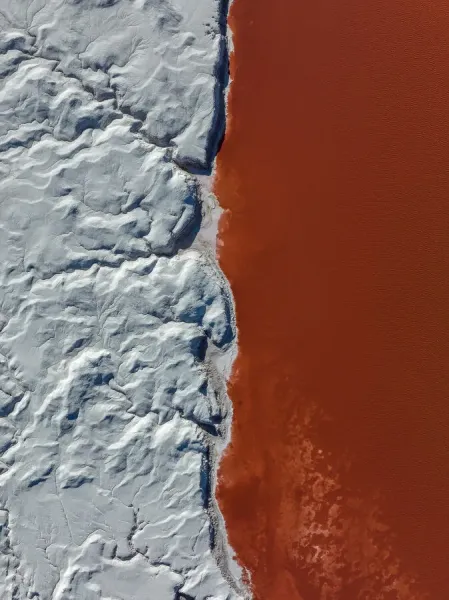
Forget everything you think you know about pink lakes. Laguna Colorada isn’t just about Dunaliella salina algae. Yes, they contribute, but the vibrant colors also come from red sediments and other types of plankton, creating a kaleidoscope of hues. What are the Laguna Colorada colors caused by? Varying depths and concentrations of these elements blend to create an unreal palette of red, pink, and orange – often all within a single frame.
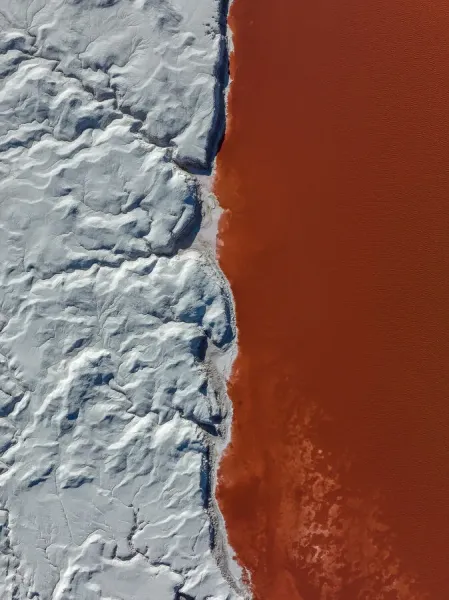
To truly capture the drama, I unleashed my DJI Mavic 3 drone. For optimal results with drone photography Laguna Colorada post processing, shoot in D-Log profile to retain maximum dynamic range for post-processing. My settings? ISO 100, f/2.8, shutter speed adjusted for proper exposure, and ND filters as needed to tame the harsh Altiplano sun. The resulting aerial shots look like abstract paintings, a testament to the power of unique perspectives. I highly recommend getting some Laguna Colorada drone footage. I had to get some Laguna Colorada aerial photos permits Bolivia, so ensure you check that your certifications are valid in Bolivia before flying!
Fujifilm Double Exposure Magic: Photography Workshop Edition
One of the highlights of my trip was running a photography workshop where I shared some of my favorite techniques. We had some fun teaching the "double exposure" technique in-camera using Fujifilm X-series cameras, specifically, the X-T4. We experimented with overlaying textures of the Salar (cracked salt patterns, close-ups of salt crystals) onto landscape portraits to create surreal and captivating effects. Fujifilm double exposure photography Bolivia is a fun technique to learn!
The in-camera settings are key: Multiple Exposure mode, Additive blending, and careful adjustment of exposure compensation for each layer. One of my students even nailed a shot of a llama silhouette against the Salar, a shot so good it got published in National Geographic Traveler! The Fujifilm X-series double exposure texture overlay method can lead to some amazing results.
Salar de Uyuni: Chasing the Mirror Effect
Ah, the legendary "mirror effect." To truly master the Salar de Uyuni mirror effect tutorial, you need rain – and patience! After a rainfall, the Salar transforms into the world’s largest mirror, reflecting the sky with stunning clarity. What is the best time to photograph the Salar de Uyuni mirror effect? Sunrise and sunset offer the most dramatic light.
Here's the secret sauce: bring a squeegee and a small team. Seriously! A squeegee helps maintain a pristine water surface for perfect reflections. My recommended camera settings are: tripod essential, use a polarizing filter to cut glare (the best polarizing filter Salar de Uyuni photography can make a huge difference), shoot in aperture priority mode (f/8-f/11 for maximum sharpness), and ISO 100. For gear, I'm partial to my Canon EOS R5 with a Canon RF 24-70mm f/2.8L lens.
How do you take a 'magic' mirror selfie Salar de Uyuni? By having some friends to help with water management!
Salteñas in Uyuni: A Flavor Explosion
Forget fancy restaurants; you need to hit up Salteñeria El Potosinito in Uyuni. Where can I find the best Salteñas in Uyuni? At Salteñeria El Potosinito! Trust me on this. Best Salteñeria Uyuni El Potosinito is the place to be. These aren't your average empanadas. Their unique seasoning blend, including a hint of anise, sets them apart. And the salteña de llama? Oh. My. Goodness. You must try the best llama salteñas in Uyuni Bolivia! Imagine this: juicy filling, slightly sweet dough, and a burst of flavor that’ll make you question every other pastry you’ve ever eaten. Read a salteñas El Potosinito Uyuni Bolivian food review and you will see what I mean!
Incahuasi Island: Cactus Kingdom
Time to get weird (in a good way). Incahuasi Island, a rocky outcrop covered in giant cacti, offers a totally different vibe. I recommend slapping a Samyang 12mm f/2.0 fisheye lens on a Sony a7III to capture the bizarre shapes of the cacti against the vast horizon. Use a low camera angle to exaggerate their size and create a sense of scale. Is there an easier way to describe a Samyang 12mm fisheye Sony a7III Incahuasi Island experience? No, because it is a very specific and unique experience.
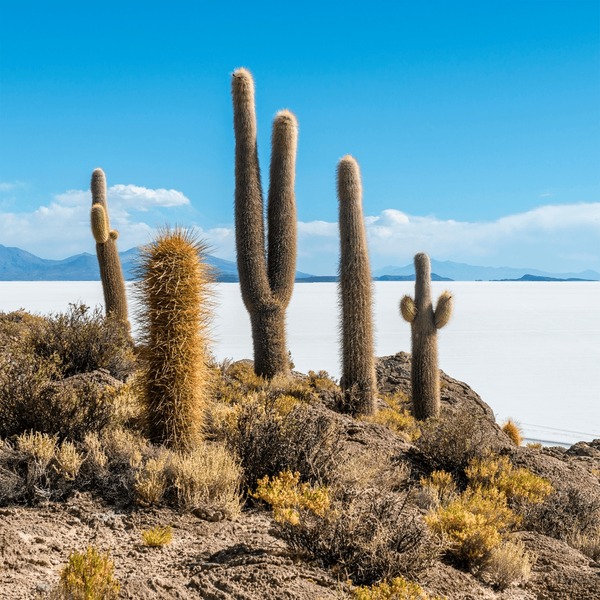
Shoot in RAW format for maximum post-processing control – you’ll need it to tame that fisheye distortion. How do I get to Incahuasi Island? Tours can be booked in Uyuni and are often included in multi-day Salar de Uyuni tours.
Viral Video Gold: Moon Landing Parody
Okay, this was possibly the most ridiculous thing I've ever done. I staged a "moon landing" parody on the Salar de Uyuni.
- HOOK: Close-up of heavily textured "footprints" sharply pressed into the white salt flats.
- SCENE: Wide shot, cinematic style, bright direct sunlight creating harsh shadows on the "moon's" surface. Me, dressed in a full astronaut spacesuit, jumping around comically in slow motion (achieved with a high frame rate), using forced perspective to make myself look tiny. The camera pulls back in a smooth, controlled orbit. I wanted to highlight how to create a forced perspective photo on Salar de Uyuni.
- TWIST: The "moon" is actually a giant, wrinkled white sheet of plastic laid on the salt flats. The sun glaring off the sheet creates a surreal, almost blinding effect.
- Technical Details: 120fps slow-motion, Shot on Sony a7S III in ProRes RAW. Custom white balance shifted significantly towards blue (around 9000K) to exaggerate the cold, alien atmosphere. Use a handheld gimbal for smooth orbiting shots.
Expect a Salar de Uyuni meme photography revolution, coming to a social media feed near you. #SalarDeUyuni #Bolivia #MoonLanding #Photography #TravelPhotography #FunnyVideo #ViralVideo #ForcedPerspective
Cinemagraph Magic: Andes Reflections
For something a bit more subtle, I created a cinemagraph of the reflection of the Andes mountains in the flooded Salar de Uyuni. Andes reflections Salar cinemagraph are amazing. The key is to focus on the rippling water surface caused by a gentle breeze, while everything else (mountains, sky, distant horizon) remains perfectly still. The Salar de Uyuni rippling water cinemagraph technique is tricky, but rewarding. Shoot at blue hour for soft, pastel colours. Use Adobe After Effects to isolate the water and create a seamless loop.
#Cinemagraph #SalarDeUyuni #Reflection #AndesMountains #BlueHour #TravelPhotography #Bolivia
Post-Processing Prowess
Post-processing is where the magic really happens. Post-processing Salar de Uyuni Lightroom tips are essential for any photographer tackling this unique landscape. For landscapes, the Lightroom Dehaze adjustment Salar de Uyuni photos is your best friend to combat atmospheric haze and boost clarity. For portraits, use the Adjustment Brush to selectively brighten eyes and sharpen details. For the fisheye cacti images, correct distortion in Lightroom using lens profiles and add a subtle vignette for extra drama. For the Laguna Colorada post processing workflow, experiment with vibrance and saturation to enhance the already intense colors.
Claim Your Adventure!
Ready to embark on your own Bolivian photography adventure? Book a Salar de Uyuni photography workshop discount with me and get 20% off with code "Salar20"! You'll also receive a free pack of my custom Lightroom presets designed specifically for processing Salar de Uyuni photos (including presets for color grading, sharpening, and noise reduction).
Battling the Altitude Blues
Let's be real – the altitude in the Altiplano is no joke. I battled headaches, shortness of breath… it was rough. How do you avoid altitude sickness in Salar de Uyuni? Acclimatize gradually, drink plenty of water, and avoid strenuous activity. But honestly, pushing through those challenges made the experience even more rewarding. Why is Salar de Uyuni so unique for photography? The sheer scale, the surreal landscapes, the unique light… it’s unlike anything else on Earth. The remote travel adds an element of adventure and remoteness to the experience.
So, what are you waiting for? Plan your trip, pack your gear, and prepare to be amazed. The Salar de Uyuni awaits!