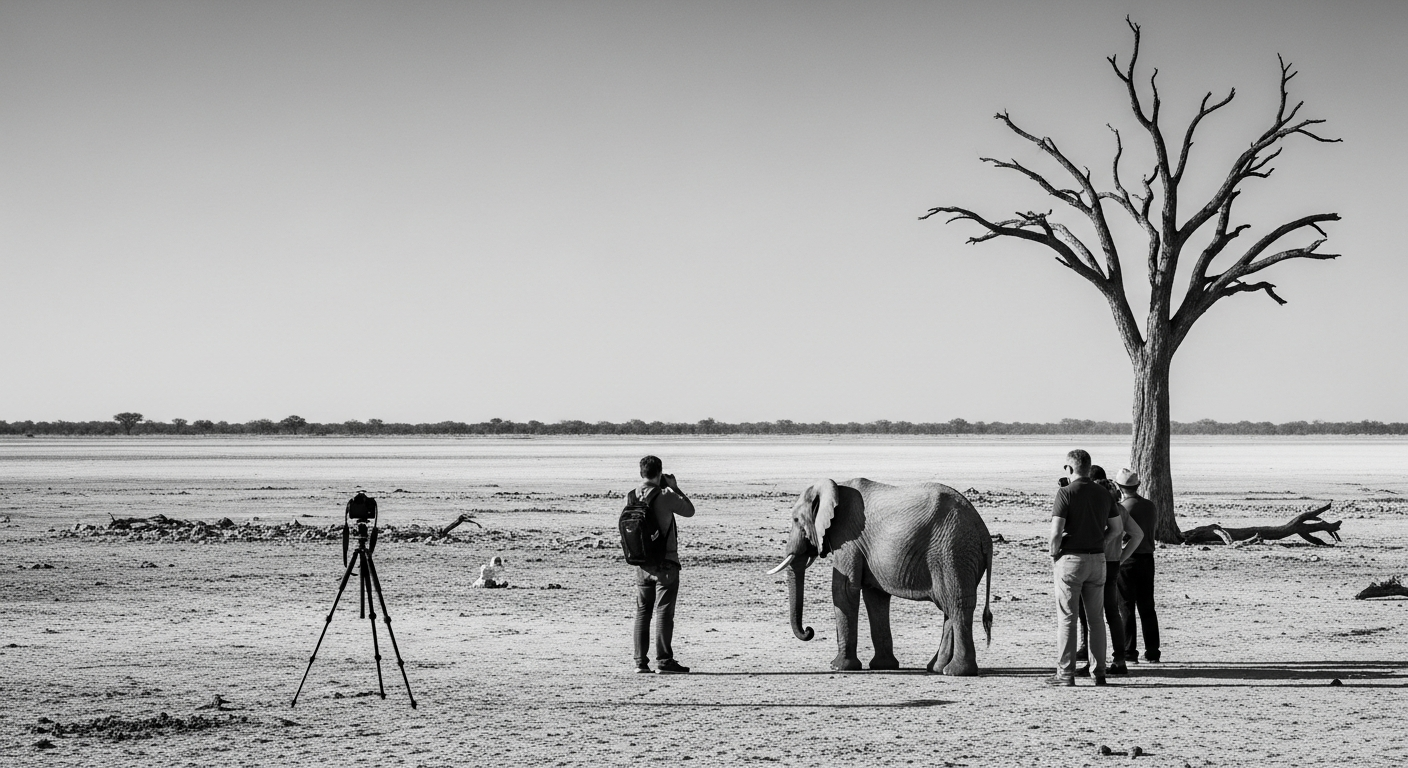
Namibia in Black and White: A Photographer's Jou...
Namibia. Even the name evokes a sense of stark beauty, of ancient landscapes sculpted by wind and time. As a wildlife photographer, I'm drawn to places that challenge my vision, that force me to see beyond the obvious. This self-drive safari through Namibia, focusing on Namibia black and white photography, was exactly that. The raw power of Etosha, the haunting desolation of the Skeleton Coast, the warmth of the Himba people – all etched themselves onto my soul, and onto my monochrome frames. This is my reflective review of that incredible journey.
Etosha National Park Photography Workshop: A Symphony of Grays
Etosha National Park is a photographer’s dream, a vast stage where wildlife dramas unfold daily. For three days, I had the privilege of leading a Namibia photography tour workshop here, guiding fellow enthusiasts through the art of capturing its essence in black and white.

We focused on techniques to enhance contrast and texture. In the harsh Namibian sunlight, using high contrast filters became essential to pull out details often lost in the glare. Shooting in manual mode was non-negotiable, allowing us to control every aspect of exposure and truly sculpt the light. My recommended equipment for this type of work includes a robust camera body like a Nikon D850 coupled with a versatile 200-500mm lens, mounted on a sturdy tripod. The tripod is essential for long exposures and sharp images, especially when the light is fading.
One evening, while photographing near the Okaukuejo waterhole, I managed to capture what I consider one of my best shots of the trip. A solitary black rhino emerged from the bush, its silhouette stark against the white expanse of the Etosha pan, illuminated by the setting sun. I used a long exposure to smooth the water's surface and emphasize the rhino's powerful form. The long exposure helped reduce the noise in the image, enhancing the dramatic effect.
Challenges and Triumphs
The photography workshop Etosha National Park for beginners had some challenges. The pervasive dust was a constant battle, requiring diligent cleaning of lenses and sensors. The intense heat tested both equipment and endurance. Hydration was key, and we learned to shield our gear from the sun whenever possible. But these challenges only amplified the sense of accomplishment when we captured a truly stunning image. My workshop attendees came away with unique insights, stunning portfolios, and a profound appreciation for the beauty of monochrome photography in the wild.
Desert Elephants of the Hoanib River: Ghosts in the Gravel Plains
Leaving the relative abundance of Etosha behind, I ventured into the stark and unforgiving landscapes of the Hoanib River in search of the desert elephants. The landscape shifted to gravel plains stretching to the horizon, punctuated by rocky outcrops and the occasional hardy acacia tree.

These elephants are a testament to adaptation, surviving in an environment where water is scarce and resources are limited. Tracking them was a test of patience and perseverance. The challenge was capturing the vastness of the landscape while still highlighting the elephants' presence. I found myself constantly adjusting my composition, trying to find the right balance between scale and detail.
Photographing Desert Elephants Responsibly
Photographing the desert elephant photography Hoanib River requires utmost respect. We maintained a safe distance, never crowding the animals or interfering with their natural behavior. We hired a local guide who understood their movements and could anticipate their needs, ensuring a minimal impact on their fragile ecosystem. Observing these magnificent creatures navigate their harsh world was a humbling experience, a reminder of the resilience of life in the face of adversity.
Cultural Immersion with the Himba People: Portraits of Dignity
A trip to Namibia wouldn’t be complete without encountering its vibrant cultures. I visited a Himba village, seeking to capture their unique traditions and way of life through my lens. However, this visit came with a deep responsibility: to practice ethical Himba village visit Namibia.

Ethical Considerations
I approached the village elders to request permission to photograph, explaining my intentions and emphasizing my respect for their culture. Informed consent was paramount. We agreed on a donation to their health clinic in exchange for the opportunity to document their lives. It's essential that such visits contribute positively to the community. We also followed the Himba village visit photography guidelines Namibia.
I spent time simply observing, talking (through a translator), and learning about their customs. When I did take portraits, I focused on capturing their dignity and strength. One particular interaction stands out: a quiet conversation with a Himba woman as she ground ochre pigment, her hands stained red, her eyes filled with wisdom. Her portrait, captured in soft, diffused light, became a powerful symbol of resilience and cultural pride.
Braaivleis at Halali Camp: A Culinary Adventure (Almost)
After long days in the field, there’s nothing quite like relaxing at one of Etosha's camps. I spent an evening at Halali Camp, indulging in a traditional Namibian braaivleis.

The air was thick with the aroma of grilling meat and wood smoke. The sounds of laughter and conversation filled the air. The sights are simply amazing, I had the pleasure of trying grilled kudu and oryx sausages, both of which were delicious. I learned what braaivleis at Halali Camp Etosha experience meant for locals and tourists. I even saw "Mopane worms" offered as a delicacy, but I politely declined.
Landscape Contrasts: A Study in Minimalism
Namibia’s landscapes are a masterclass in contrast, a study in minimalism that challenges my artistic vision.
The White Silence of Etosha
The Etosha salt pans are otherworldly. Vast, white expanses that stretch to the horizon, blurring the line between earth and sky. Their emptiness is both captivating and unsettling. The challenge is to capture their immensity, their silent power. I found myself focusing on subtle textures and patterns in the cracked earth, searching for elements that could provide a sense of scale. This is the best place to photograph the best time to photograph Etosha salt pans.

The monochrome medium was particularly effective here, stripping away the distractions of color and emphasizing the starkness of the environment. The vastness of the plain, with only a lone tree or animal to break the horizon, underscores the scale of nature.
Sossusvlei's Fiery Embrace
A brief interlude took me to Sossusvlei, home to some of the world's highest sand dunes. The towering red dunes against the azure sky were a breathtaking sight. The surreal quality of the landscape at sunrise, with the long shadows and intense colors, was truly unforgettable. I was able to capture some stunning landscapes by experimenting with different angles and viewpoints.
The Desolate Beauty of the Skeleton Coast
The Skeleton Coast self-drive photography adventure is not for the faint of heart. This desolate stretch of coastline is a graveyard for ships, their rusting hulls serving as haunting reminders of the ocean's power.

Photographing the shipwrecks was an eerie experience. The isolation was profound, the environment unforgiving. The wind howled relentlessly, and the waves crashed against the shore with a primal force. I used graduated neutral density filters to balance the bright sky with the dark foreground, capturing the dramatic contrast between the decaying ships and the turbulent sea.
Anya's Internal Reflections: Finding Beauty in Simplicity
Namibia has profoundly impacted my artistic vision. Its starkness and simplicity have challenged me to find beauty in minimalism, to appreciate the power of negative space. The monochrome medium has become my tool for distilling the essence of a subject, stripping away distractions and focusing on form, texture, and light.
As a wildlife photographer, I feel a deep responsibility to document and protect these fragile ecosystems. My photographs are not just images; they are a call to action, a plea to preserve the beauty and biodiversity of our planet. Ethical wildlife photography workshop Namibia should be more prevalent in this region of the world. It is essential to avoid interfering with wildlife behavior and respecting their natural habitat.
Photographic Challenges and Successes: Lessons Learned
Dealing with dust storms was a constant challenge. I learned to protect my equipment meticulously and to be patient, waiting for the dust to settle before shooting. Capturing sharp images in low light required a steady hand and a fast lens. I often pushed my ISO limits, accepting a bit of noise in exchange for a compelling image.
One of my most successful shots was capturing a leopard silhouetted against a rocky outcrop at dusk. The light was fading fast, but I managed to nail the focus and exposure, creating a dramatic and evocative image. It was a challenging shot, but the reward was immense.
A Call to Action: Support Conservation and Responsible Tourism
Namibia is a land of unparalleled beauty and rich biodiversity. But it's also a fragile ecosystem that faces numerous challenges. We can all play a part in protecting it. I encourage you to support organizations like the Namibia Nature Foundation and the Cheetah Conservation Fund, which are working tirelessly to promote responsible wildlife photography and conservation in Namibia. This is your cue to support responsible tourism Namibia Himba.
If you're an aspiring photographer, I urge you to visit Namibia responsibly and ethically. Learn about its cultures, respect its wildlife, and leave no trace behind. Let your photographs be a testament to its beauty and a call for its preservation.
By traveling responsibly, we are helping preserve these wonders for generations to come.