Earth's Living Geology: Unveiling the Science Be...
Beaches often conjure images of sunbathing, swimming, and building sandcastles. But some coastlines offer more than just recreation; they present a fascinating glimpse into Earth's history, shaped by powerful geological forces over millions of years. These unique rock formations beaches aren't just beautiful landscapes; they're open-air museums showcasing the dynamic processes that have sculpted our planet. From the dramatic basalt columns of Ireland to the mysterious spherical boulders of New Zealand, we'll explore three stunning examples of earth's living geology and understand the science behind their creation.
Giant's Causeway, Northern Ireland: Nature's Geometric Masterpiece
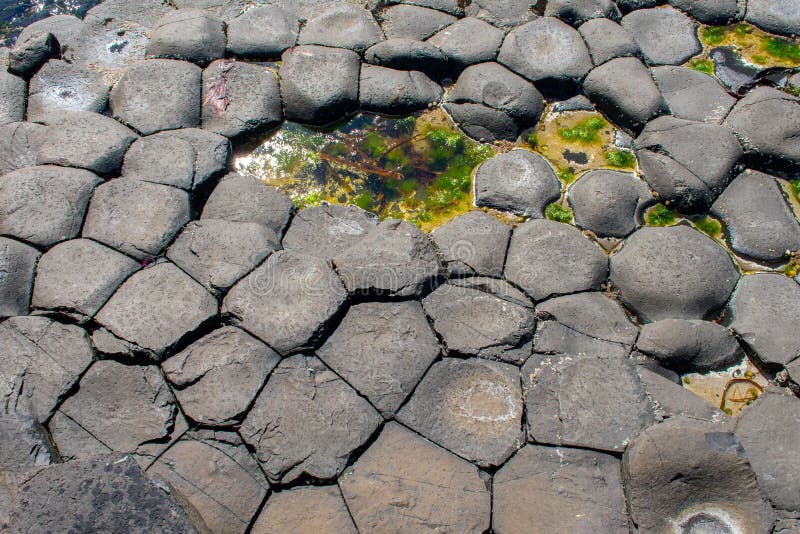
The Giant's Causeway, a UNESCO World Heritage Site on the coast of Northern Ireland, is a breathtaking spectacle of around 40,000 interlocking basalt columns. These predominantly hexagonal columns create a pavement-like landscape that has captivated visitors for centuries. Legend has it that the causeway was built by the giant Finn McCool as a pathway to Scotland. However, the true story, revealed by geological science, is even more impressive. The Giant's Causeway Geology is not the work of a giant, but of intense volcanic activity dating back 50 to 60 million years.
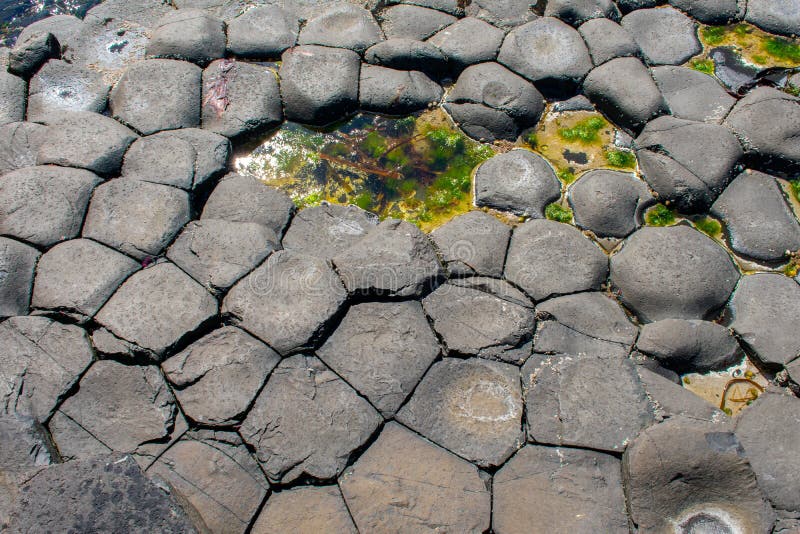
During the Paleocene epoch, intense volcanic eruptions spewed molten basalt lava onto the Antrim Plateau. As this lava cooled relatively quickly, it contracted and fractured. This process, known as columnar jointing, resulted in the formation of the characteristic hexagonal columns. The size and shape of the columns are determined by the rate of cooling; faster cooling typically leads to smaller columns. Other Volcanic rock beaches display hexagonal jointing to a similar degree, but the Giant's Causeway displays an exceptionally uniform and extensive example of the phenomenon.
Columnar Jointing Explained
Imagine a puddle of mud drying in the sun. As the mud loses moisture, it shrinks and cracks, often forming a pattern of polygonal shapes. Columnar jointing is similar, but on a much grander scale and with molten rock. The lava cools from the surface downwards, creating stress within the rock. These stresses are relieved by the formation of fractures that propagate downwards, creating the columns. The hexagonal shape is the most efficient way to relieve stress uniformly throughout the cooling mass.
[Diagram illustrating columnar jointing will be inserted here.]
Visiting Giant's Causeway from Belfast
Many tours depart from Belfast daily. Visit Giant's Causeway from Belfast for bookings and availability.
Moeraki Boulders, New Zealand: Spherical Mysteries of the Shoreline
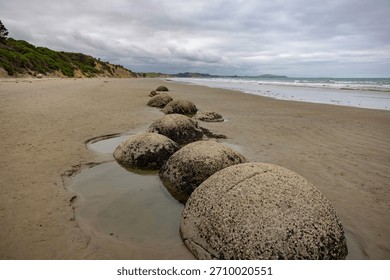
Scattered along Koekohe Beach on the Otago coast of New Zealand's South Island lie the Moeraki Boulders – large, spherical concretions that appear like giant marbles left behind by some ancient game. These unique rock formations beaches are not volcanic in origin; instead, they were formed through a process of mineral precipitation within marine mudstone over millions of years. The Moeraki Boulders Formation is a fascinating tale of slow geological processes.
The Formation of Concretions
Concretions form when minerals precipitate out of solution around a central core. This core could be a fossil, a shell fragment, or even a small piece of organic matter. In the case of the Moeraki Boulders, the process began within ancient seafloor sediments.
Here’s how it works:
- Core Formation: A small object acts as a nucleus for mineral accumulation.
- Mineral Precipitation: Water rich in calcite (calcium carbonate) and other minerals seeps through the sediment.
- Layer-by-Layer Growth: The minerals precipitate out of the water and deposit around the core, forming concentric layers, much like the rings of a tree.
- Hardening: Over millions of years, the concretions harden as the minerals crystallize and bind the sediment together.
- Exposure: Coastal erosion gradually wears away the surrounding mudstone, eventually exposing the Moeraki Boulders on the beach.
Many Moeraki Boulders display septarian cracks – fractures that formed within the concretion as it dried and shrank. These cracks are often filled with calcite or other minerals, creating intricate patterns. While some believe the Moeraki Boulders are man made, science clearly shows the natural processes at work.
Best time to visit Moeraki Boulders for photography
Sunrise offers the best light for capturing the boulders' unique textures and shapes.
Pancake Rocks and Blowholes, Punakaiki, New Zealand: A Layered History Etched by the Sea
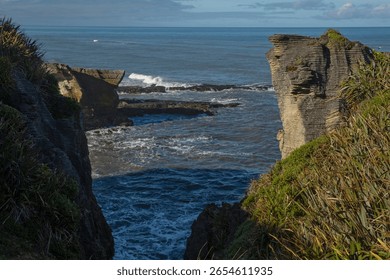
On the west coast of New Zealand's South Island, near the small town of Punakaiki, lies another geological marvel: the Pancake Rocks and Blowholes. These unusual formations, part of the Paparoa National Park, resemble stacks of pancakes, earning them their descriptive name. The Pancake Rocks Geology New Zealand showcases a different type of sedimentary rock beach formations, shaped by the relentless forces of wind and water.
From Seafloor to Striking Landscape
The Pancake Rocks are composed of heavily layered limestone, formed approximately 30 million years ago from the accumulation of marine organisms and sediments on the seabed. Over time, immense pressure compressed these layers into solid rock. Subsequent uplift exposed these formations to the elements, and the relentless action of wind and water began to sculpt them into their present-day appearance.
The Power of the Blowholes
The blowholes are a particularly dramatic feature of the Pancake Rocks. They formed when the ocean waves exploited weaknesses in the limestone, eroding tunnels and vertical shafts within the rock. When a large wave crashes against the coast, the water is forced into these tunnels. The pressure builds, and the water eventually erupts through the blowholes, creating spectacular plumes of spray and a thunderous roar. The frequency and intensity of the blowholes are dependent on the tide and sea conditions. Viewing tips include going at high tide to see best results.
Punakaiki Pancake Rocks accommodation nearby
Many hotels and B&Bs are located within walking distance of the Pancake Rocks. Check availabilty here.
Earth's Canvas: Beaches Through Science and Art – User-Generated Content Contest!
These incredible beaches are more than just geological wonders; they're also sources of inspiration for artists, photographers, and storytellers. We invite you to share your scientific and artistic interpretations of these geological wonders in our "Earth's Canvas: Beaches Through Science and Art" User-Generated Content Contest! Blend stunning photography, videography, geological explanations, and creative storytelling for a chance to win amazing prizes! Are you ready to enter the Vistalocation UGC contest?
Contest Prizes:
- First Prize: An all-expenses-paid, guided geological tour of the Bay of Fundy, Canada, to witness its extreme tides and explore its rich geological history.
- Second Prize: A high-quality microscope kit, perfect for exploring geological samples and uncovering microscopic details of Earth's processes.
- Third Prize: A one-year subscription to 'Nature' or 'Scientific American,' providing cutting-edge scientific research and discoveries.
Detailed contest rules and submission guidelines can be found here.
Conclusion: A Testament to Earth's Enduring Power
The Giant's Causeway, the Moeraki Boulders, and the Pancake Rocks are just a few examples of the many geological marvels that can be found on Earth's coastlines. They offer a unique opportunity to witness the power of geological processes and to appreciate the incredible diversity of our planet. These geological beaches remind us that Earth is a dynamic and ever-changing place, and that even the most seemingly solid landscapes are constantly being reshaped by the forces of nature. What other geological beaches are there in the world? Start planning your trip today and witness these wonders for yourself!
Share your awe-inspiring photos and videos of these incredible beaches on social media using the hashtag #VistalocationGeology.
Viral Video Plan: Giant's Causeway (Target Platform: TikTok/Instagram Reels)
- HOOK (0-3 seconds): Start with a macro shot of a perfectly formed hexagonal basalt column, highlighting its geometric precision. Use high-resolution slow-motion footage. Overlay text: "Nature's Geometry."
- SCENE (3-15 seconds): Execute a sweeping drone shot that reveals the vast scale of the Giant's Causeway, emphasizing the sheer number and uniformity of the columns. Insert animated diagrams illustrating the volcanic eruption and the process of columnar jointing. Include timestamps on the diagram showing millions of years passing.
- TWIST (15-20 seconds): Create a visually compelling time-lapse showing the changing tides dramatically impacting the Giant's Causeway, with waves crashing and receding. End with a shot of diverse tourists exploring the area, expressing awe and wonder. Fade to black. Display the Vistalocation.com logo and tagline: "Explore. Discover. Vistalocation.com." Add upbeat, inspiring music throughout the video.